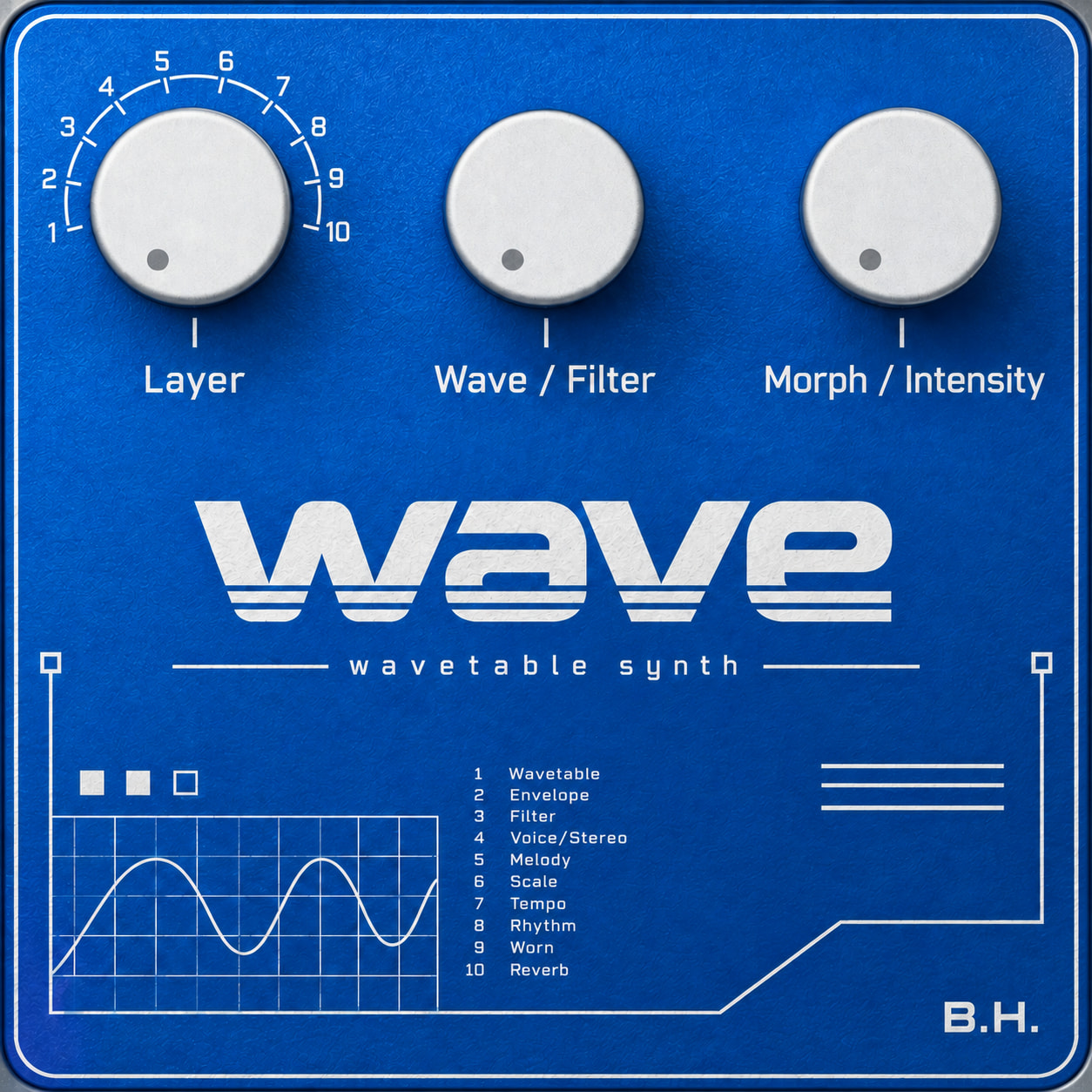
(programmed in C++) Wave is a rough 12-bit wavetable synth for evolving melancholic melodies, with tempo-synced morphing, worn digital character, filtering and reverb. Long Press records your own melodies and turns them into playable sequences
File(s)
Description
WAVE — 12-Bit Wavetable Synth
Wave is a melodic wavetable synthesizer designed around rough, imperfect and slightly unstable digital timbres.
Its embedded 12-bit wavetables deliberately retain aliasing, grain and early-digital character instead of sounding clinically clean.
Tempo-synchronized wavetable movement allows static tones to develop slowly into animated and evolving textures.
Attack, release, filtering, detuning and stereo spread can transform the same table from fragile plucks into wide ambient voices.
An integrated melody engine provides preset melodic material that can be altered through variation, scale, root note, tempo and rhythmic division.
A Worn section introduces twelve different degradation characters ranging from subtle aging to strongly deteriorated digital and tape-like coloration.
A spacious reverb stage places the wavetable voices inside large atmospheric environments while preserving their melodic definition.
Most importantly, a long footswitch press activates Melody Capture, allowing the musician to play and record an entirely new melody directly into Wave.
The resulting melody is analyzed, quantized and then becomes part of the synthesizer itself, turning Wave from a preset instrument into a personal melodic instrument.
Layer architecture
| Layer | Function | Knob 2 | Knob 3 |
|---|---|---|---|
| 1 — Wavetable | Core oscillator / wavetable selection | Selects the embedded wavetable positions and waveform material | Tempo-synchronized Frame / Morph Time – controls how quickly the wavetable evolves |
| 2 — Envelope | Voice articulation | Attack – from very immediate to softer entrances | Release – from short notes to long ambient tails |
| 3 — Filter | Spectral shaping | Cutoff | Filter Morph / Character – changes the tonal response and filter coloration |
| 4 — Voice / Stereo | Width and instability | Detune – increases tonal separation between voices | Stereo Spread – distributes voices across the stereo field |
| 5 — Melody | Melodic material | Selects the melody preset / captured user melody | Variation – changes or develops the selected melody |
| 6 — Scale | Harmonic framework | Selects the musical scale | Selects the root note |
| 7 — Tempo | Global melodic timing | 40–160 BPM | Tempo-synchronized division |
| 8 — Rhythm | Note behaviour | Gate Length | Humanize – introduces controlled timing/playing variation |
| 9 — Worn | Aging / degradation | Far left = Bypass, then 12 Worn presets | Intensity of the selected degradation character |
| 10 — Reverb | Final spatial stage | Selects / shapes the reverb character | Dry / Wet |
Knob 1 is the global layer selector and moves through Layers 1–10. The settings of the individual layers remain stored when another layer is selected.
Footswitch & Melody Capture
The most important performance feature of Wave is the Long Press Melody Capture. A long press starts a one-bar count-in and then Wave listens to the melody you play. It captures the essential musical information — pitch, note onset, note length and velocity — rather than merely recording an audio loop.
The recorded performance is placed on a fixed 1/8-note grid and can contain up to approximately 12 bars / 96 eighth-note steps. A long press while the count-in is running cancels the operation; a long press during recording finishes the capture cleanly and the newly created melody begins playback.
That means you are not restricted to the factory melodies: you can play a completely original melody into Wave and then process that melody through the wavetable engine, scales, rhythm, filter, Worn section and reverb.
A short footswitch press stores a newly captured melody into an available user-melody position. A double short presscan remove the most recently stored user melody.
The essential concept is therefore:
Play melody → Long Press → 1-bar count-in → record your performance → automatic analysis/quantization → your melody becomes part of Wave → reshape it with the 10 synthesis layers.