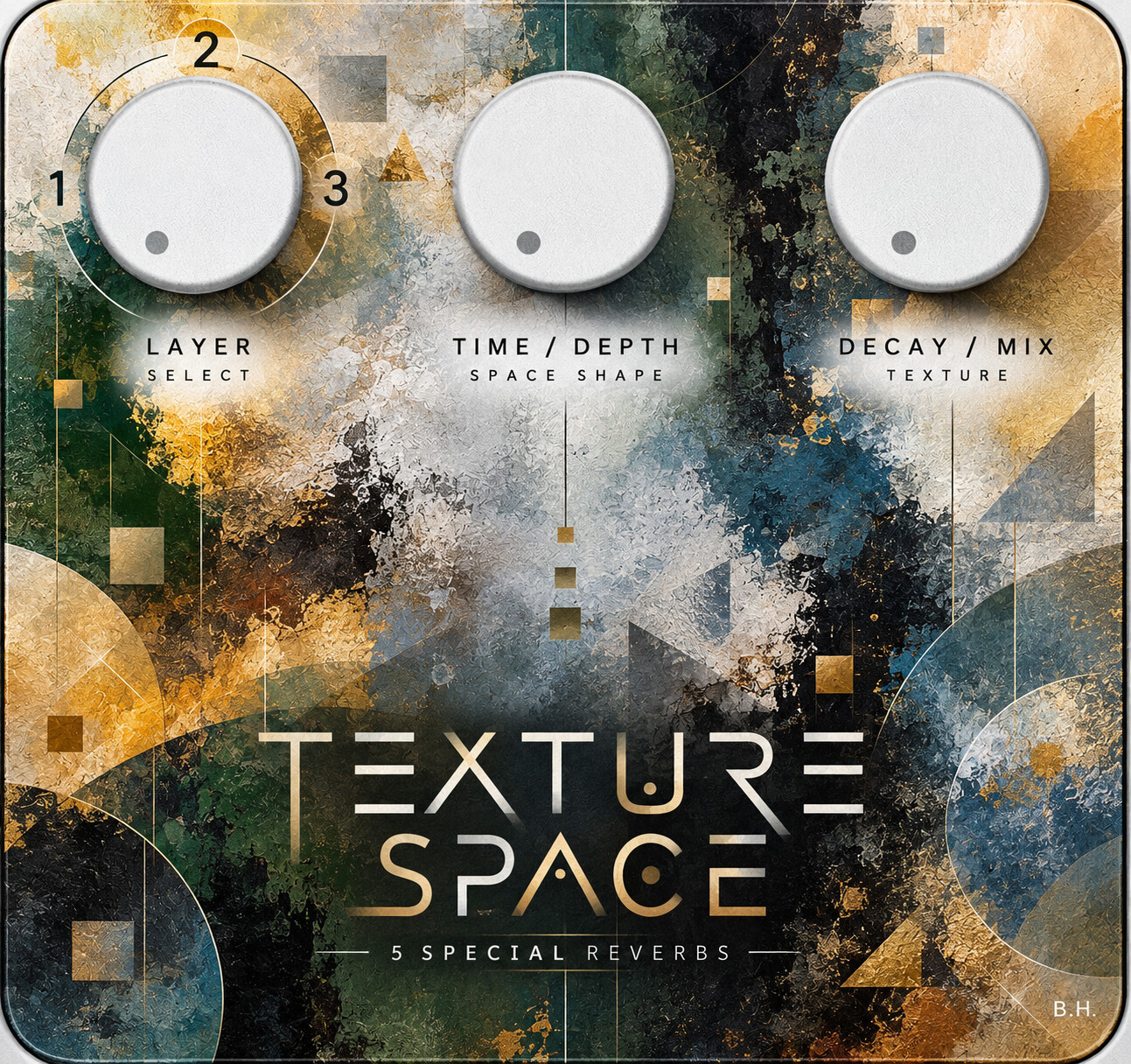
(programmed in C++) Texture Space is a five-engine spatial processor for evolving ambient depth: resonant orbits, spectral memory, stretched alien rooms, bubbling reverb events and velvet phrase spaces, with smooth morphing and model-specific holds.
File(s)
Description
Texture Space is a five-engine spatial processor designed for evolving ambient and experimental sound.
Its engines range from narrow metallic resonance to huge, diffuse stereo environments.
Dual Resonant Orbit places two moving mono resonant cores inside a wider spatial cloud.
Spectral Memory combines repeats, resonators, diffusion and a memory structure that can slowly disappear.
Dual Alien Space Evolution stretches the left and right channels independently and can evolve them through synchronized or independent random morphs.
Surface Bubbles creates discrete reverb events that change size, transformation, material, width and energy.
Velvet Horizon rotates between Dense, Air and Silk spaces after qualified pauses in the input signal.
Knob 1 selects the three control layers, while Knobs 2 and 3 change the parameters assigned to the active model and layer.
A short footswitch press advances through the five engines, while a long press activates each engine’s dedicated evolutionary function.
Effects and Controls
| Effect | LED | Knob 1 | Knob 2 / Knob 3 | Footswitch |
|---|---|---|---|---|
| 1. Dual Resonant Orbit | No dedicated model color defined | Selects Layer 1–3 | L1: Decay / Length · Dry/Wet L2: Dual-Core Presence & Separation · Metal Resonance L3:Dual-Orbit Tempo · Front/Back Depth Motion | Short: Next effect. Long:Living Freeze — holds and evolves the resonant spatial structure. |
| 2. Spectral Memory | No dedicated model color defined | Selects Layer 1–3 | L1: Near-dry memory repeater → resonator/diffusion/reverb morph · Dry/Wet L2:Tempo 40–140 BPM · Repeat Length 1 bar → 1/32 L3: Resonator Decay · Spectral Stereo Shape | Short: Next effect. Long:Dying Memory — the stored spectral structure slowly disappears over about 180 seconds, down to roughly −60 dB. |
| 3. Dual Alien Space Evolution | No dedicated model color defined | Selects Layer 1–3 | L1: Left Stretch 1×–10× · Right Stretch 1×–10× L2: Left Decay 1–20 s · Left Spatial Exclusion / Outer Space L3: Right Decay 1–20 s · Right Spatial Exclusion / Outer Space | Short: Next effect. Long:Independent Random → Sync Timing → Full Sync → OFF. Parameters morph smoothly instead of jumping. |
| 4. Surface Bubbles | No dedicated model color defined | Selects Layer 1–3 | L1: Bubble Size 0.25–10 s / Random Size · State Hold & pattern selection L2:Pitch/Reverse/Freeze/Random · Dark/Dense → Bright/Glass/Metallic/Random L3: Mono → Stereo → Wide → Outer Space/Random · Energy/Burst/Random | Short: Next effect. Long:Cycles pattern tempo 80 → 100 → 120 → 140 → 60 BPM without repitching already active bubbles. |
| 5. Velvet Horizon | Red during the below-threshold pause phase; otherwise normal layer/Bloom indication | Selects Layer 1–3 | L1: Tail/Decay 8–96 s · Dry/Wet L2: Pause Time 40 ms–3 s · Density/Size L3: Depth / Front-Back · Spatial Luxury / Width | Short: Next effect. Long:Golden Bloom — about a 2.5 s morph into a larger, richer space without freezing the input. |
Velvet Horizon room cycle
Dense → Air → Silk → Dense
Dense is dark, heavy and compact. Air is bass-light, distant and extremely wide. Silk is smooth and long, with a subtle +12-semitone shimmer placed only at the output rather than inside the feedback loop. When the signal remains below −35 dBFS for the selected Pause Time, the LED turns red and the next room personality is prepared.