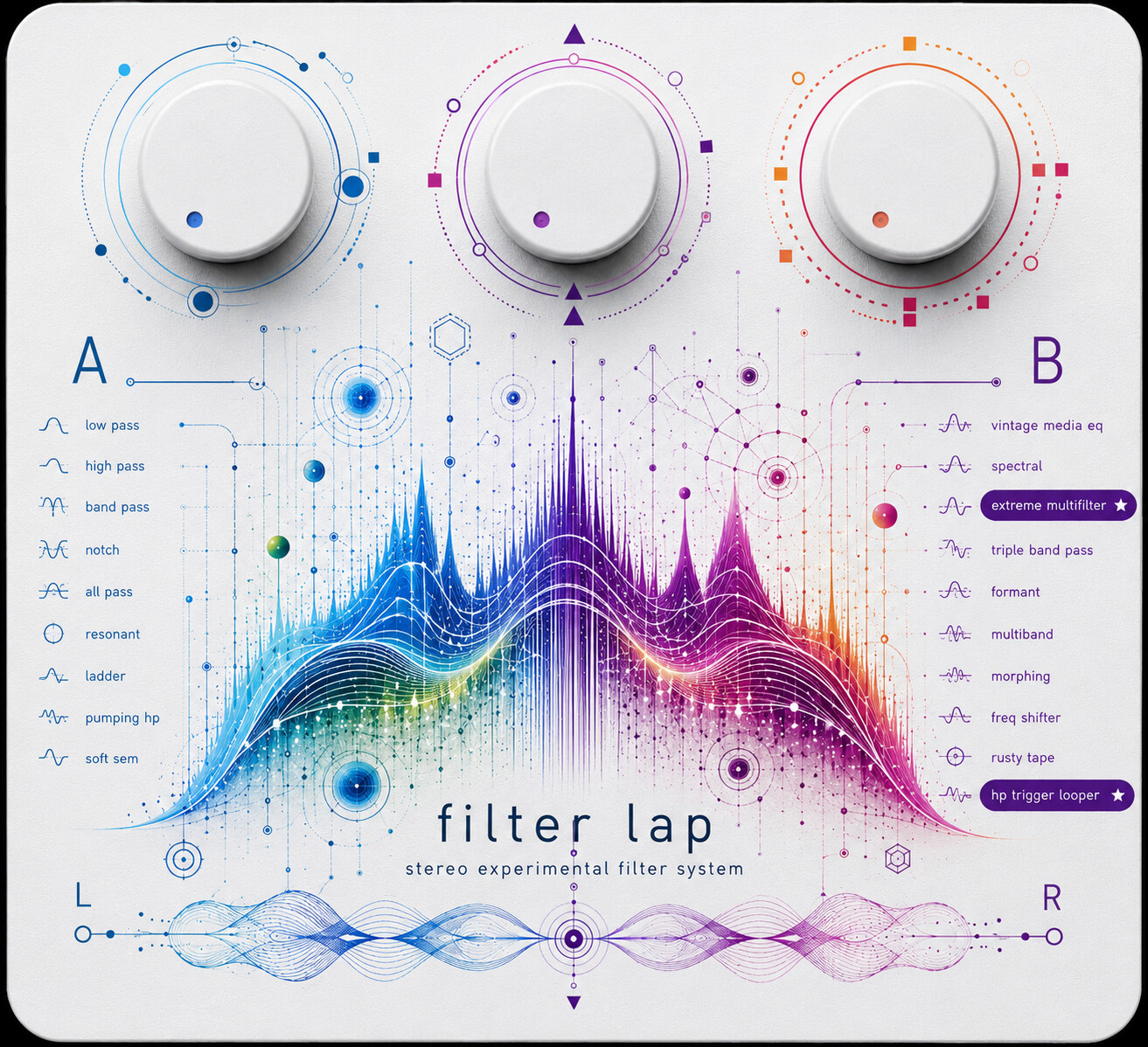
Filter Lab is a stereo experimental filter system with two banks of classic and unconventional filters, dynamic envelope control, spectral processing, saturation, stereo movement and a persistent performance looper.
File(s)
Description
Filter Lab is a stereo experimental filter system combining two banks of carefully designed classic and unconventional filter architectures. Bank A focuses on classic filter behavior, including Low-Pass, High-Pass, Band-Pass, Notch, All-Pass, Resonant, Ladder, Pumping High-Pass and Soft SEM filters. Bank B explores more unusual sonic territories, from vintage media degradation and spectral processing to extreme multiband filtering, formant filtering, frequency shifting and rusty tape textures. Every filter responds dynamically to the input signal, creating envelope-like movement rather than simply applying static filtering. Many filters incorporate dedicated saturation, resonance, stereo modulation, frequency-dependent movement or other specialized processing. The system is designed to maintain strong level compensation so that dramatic filtering does not simply result in unwanted volume loss. The Extreme Multifilter adds an exceptionally steep 46 dB/octave filter, stereo drift and a persistent 15-second stereo looper that operates independently from the filter architecture. The result is a versatile stereo filter laboratory ranging from subtle classic tone shaping to highly experimental, unstable and performance-oriented sound manipulation.
BANK A – CLASSIC FILTERS
| Nr. | Filter | Knob 1 | Knob 2 | Knob 3 |
|---|---|---|---|---|
| 1 | Low-Pass Filter | Cutoff Frequency | Resonance | Envelope Sensitivity / Dynamic Cutoff |
| 2 | High-Pass Filter | Cutoff Frequency | Resonance | Envelope Response |
| 3 | Band-Pass Filter | Center Frequency | Bandwidth / Q | Envelope Modulation Depth |
| 4 | Notch / Band-Stop | Notch Frequency | Notch Width | Envelope Movement |
| 5 | All-Pass Filter | Frequency / Phase Position | Phase Depth / Resonance | Dynamic Phase Movement |
| 6 | Resonant Filter | Resonant Frequency | Resonance | Envelope Excitation |
| 7 | Ladder Filter | Cutoff | Resonance | Drive / Saturation |
| 8 | Aggressive Pumping High-Pass | High-Pass Cutoff | Compressor Pumping | Compressor Release / Pump Character |
| 9 | Soft SEM Filter | Filter Frequency | LP ↔ HP / Resonance | Envelope Softness / Dynamic Response |
All filters are designed for stereo operation. A short press selects the filter type, while a long press selects the filter bank.
BANK B – SPECIAL FILTERS
| Nr. | Filter | Knob 1 | Knob 2 | Knob 3 |
|---|---|---|---|---|
| 1 | Vintage Media EQ | 8 Vintage-EQ-Presets | Multifilter: LP ← Neutral → HP | Saturation + Dropouts |
| 2 | Spectral Filter | Spectral Position | Spectral Width | Spectral Motion / Envelope Sensitivity |
| 3 | Extreme Multifilter* | Filter Frequency | Stereo Drift 0–150 ms + Random-Modus | LP → BP → HP + Global Looper |
| 4 | Triple-Band-Pass Stereo | Overall Frequency Position | Bandwidth / Q | Saturation / Mild Distortion |
| 5 | Formant Filter | Formant Position | Vowel Morph | Formant Resonance |
| 6 | Multiband Filter | Spectral Center | LFO Speed 0,05–40 Hz | LFO Depth |
| 7 | Morphing Filter | Base Morph Position | Morph Character / Width | Trigger Threshold −65 dB → 0 dB |
| 8 | Frequency Shifter | Frequency Shift Amount | Feedback / Spectral Character | Envelope Shift Depth |
| 9 | Rusty Tape Filter | LP ← Neutral → HP | Haas Stereo Width | Saturation + Abrasion + Dropouts |
| 10 | High-Pass Stereo Trigger Looper | HP Cutoff | HP Resonance | Trigger Threshold −65 dB → 0 dB |
The Extreme Multifilter contains a separate 15-second stereo looper at the very end of the signal chain, so recorded material remains audible even when another filter or bank is selected. Turning Knob 3 fully right arms recording; the LED stays solid red until the incoming signal exceeds −45 dB, then recording begins and the LED blinks red. The loop can be overdubbed repeatedly with 50 ms fade-in/out, plays back at −4 dB, supports forward/reverse playback and synchronized stereo movement, while the lowest-left Knob 3 region generates a new stereo trajectory after every loop cycle. Turning Knob 3 fully left deletes the entire buffer with a 3-second fade-out.