Is this an interesting idea? Polyend Glass
The interface is the instrument. The interface is the experience.
A discussion for Polyend Backstage
| November 1, 2026
Here’s an idea from an enthusiastic Polyend user wanting to plant some ideas and kick off a conversation.
NOTE: I have no view into Polyend’s internal code, component costs, or product roadmaps, and only the Polyend team can judge what is technically or commercially realistic. My hope is simply to pitch an idea, a direction, kick the tires, and see how the Backstage community would tear it apart and improve it.
The Idea at a Glance
How to build a Polyend instrument that can tap into the energy and creativity of the open-source synth movement, in a capable quality performance instrument, while retaining the price-points, design and desirability of the Polyend brand?
What if a single Polyend instrument could become dozens of completely different instruments, where the physical playing surface fundamentally changes to fit the music being made?
The 4 Pillars of the Glass Concept:
- A Glass Frame (The Hardware): A tactile dock built by Polyend that communicates with an iPad or tablet. The iPad supplies the high-res touch glass and processing power; Polyend supplies the physical interface, balanced audio/MIDI I/O…
- A Glass Canvas (The Web Builder): An in-browser visual workspace to wire Polyend sound engines, sequencers, and UI widgets together.
- A Web Emulator (Try Before You Flash): A playable browser preview. Community creators don’t post dead code files; they post a playable link you can tap and hear in 10 seconds.
- An Open-Source “Core + Plugin” Ecosystem: Polyend keeps its proprietary DSP engines and hardware firmware locked and stable. Everything built on top (sequencing logic, generative scripts, UI templates, and routing) lives in an open-source community layer where creators can freely build, inspect, and fork new instruments.
1. Why Now? The $75 Reality Check
The M-VAVE FM-1 is a signal. A starting gun? Running community-developed alternative firmware like JIANT FM, a modest sub-$80 box delivers multi-track sequencing, multiple synthesis engines, modulation, and generative features. Experienced electronic musicians who own rigs worth thousands of dollars are buying lots of them and genuinely enjoying them. There are more than 175 open-sourced firmwares for the FM1 and M-VAVE seems to have already started work on a more powerful FM2.
A huge part of the FM-1’s appeal is it gives developers open-source access to exploit a built-in TFT color screen. Rather than the tiny, cramped monochrome displays seen on the Elektron Model:Cycles or C&G Organelle, developers can use the FM-1’s color display to build expressive, multi-track custom interfaces on the fly. Combining open-source developer freedom with a color TFT screen has allowed it to punch far above its weight.
The result is capable digital synthesis and sequencing no longer require expensive, dedicated silicon. When commodity microcontrollers can run complex code, competing purely on spec sheets means $400–$900 devices could get squeezed.
It’s always the “middle” offerings that get squeezed when lower cost alternatives arrive. Higher end price points with reputations, heritage and strong brands that never sold in great numbers are less impacted. And “bottom cost” solutions are less impacted too. It’s always the “middle cost brands” that feel the biggest impact when lower cost alternatives that offer “more” enter markets.
When raw features are getting cheap, what keeps musicians loyal is what Polyend already excels at:
- inspiring workflows
- tactile surfaces and industrial design
- big color screens compared to alternatives in the same class
- instruments that are simply fun to play
The Glass idea would want to build a forward-looking platform around those strengths.
2. Three Points of Reference: Plinky12, Empress ZOIA, and the FM-1
Three existing instruments point to how this might work:
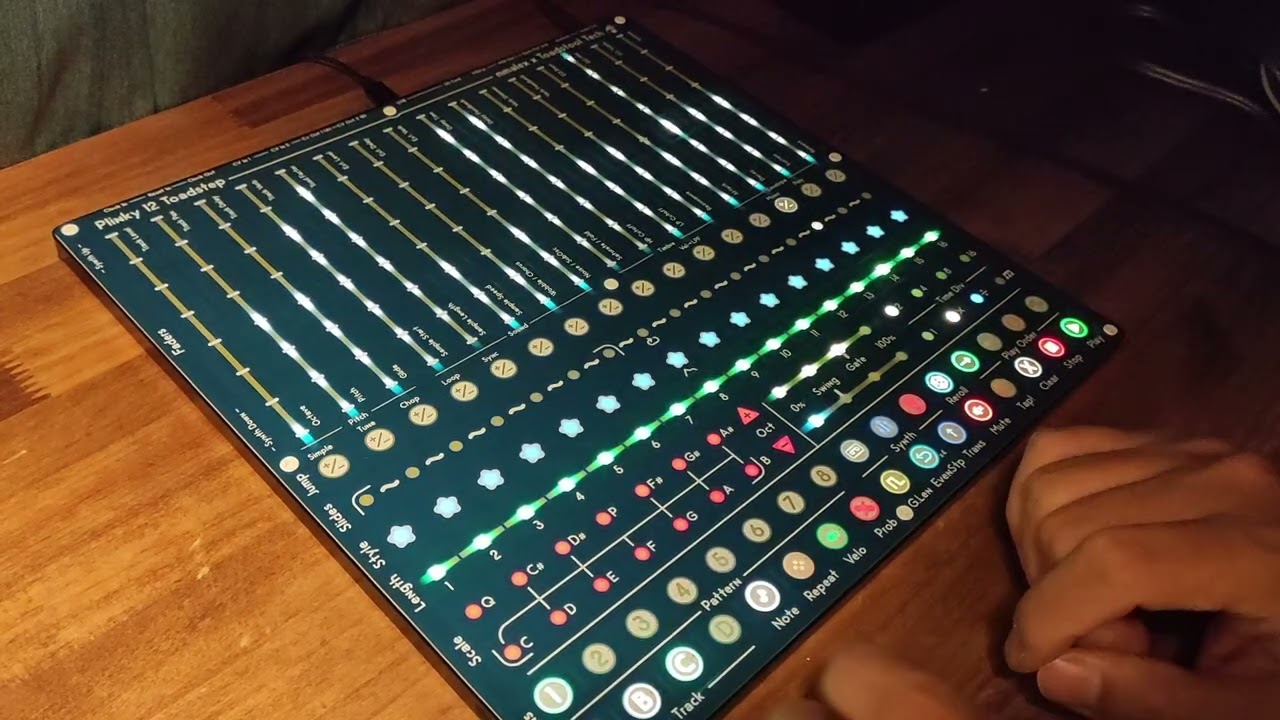
- Plinky 12 (The surface shapes the music): Plinky’s interchangeable faceplates (Chords, Toadstep, Blocks) turn the same synth engine into completely different instruments without menu diving. Plinky’s web ecosystem proves low-friction development works: its in-browser Web IDE, touch emulator, and WebUSB one-click flashing prove you don’t need complicated command-line toolchains to let users build and share custom layouts.
- Empress ZOIA (Modular blocks work, but static layouts): ZOIA proved that musicians can build instruments by wiring modular blocks together without writing code. But it hit a physical wall: no matter your patch is, you’re still performing it through a static 8×5 grid of tiny buttons and one encoder.
- M-VAVE FM-1 (Great software variety, tight physical limits): The FM-1 proves how much variety a passionate community can extract from hardware. In a month we’ve seen more than 175 open-source firmwares. But every FM1 creator is cramming their ideas onto a tiny screen.
The Opportunity? Combine the modular block patching of ZOIA, the community variety of the FM-1, and the adaptable playing surface and zero-install web tools of Plinky.
3. Build on Canvas, Play on Glass
Using an electronic instrument has two distinct phases:
- Building the patch
- Performing with it
1. BUILD (Web Canvas) - Wire Polyend engines, sequencers & UI on your screen
2. TEST & SHARE (Interactive Emulator) - Play-test in your browser; share playable links
3. PERFORM (Glass / Glass Frame) - Construction menus vanish. Pure tactile performance.
- The Canvas (standalone or in the browser): Building an instrument belongs on a spacious screen / monitor. You visually wire together Polyend sound engines, sequencers, and modulation blocks, or use an Endless-style natural language prompt: “Create a 4-voice drone with an ambient chord progression and a master density ribbon.”
- The Glass Surface (under your hands): When it’s time to perform, Glass would display only the live controls: macro ribbons, touch zones, and step triggers, whatever… anchored by Polyend’s physical interface, encoders, buttons, rollers.
4. The Interactive Emulator
Why do projects like JIANT FM and Plinky capture attention while dozens of other clever firmware builds disappeared into forum obscurity?
I’d suggest their interactive browser previews makes the difference, because the biggest hurdle with community gear is buyer hesitation:
- Will I actually use this?
- Will I be inspired and feel confident of my success doing cool things with this?
- Is it going to be a headache to install/set-up/integrate/play?
An interactive browser-based emulator is much more impactful for a prospective buyer than passive YouTube videos.
By including an in-browser emulator in the Canvas toolchain, creators don’t post inert code files, they post a playable link. You open it, tap virtual pads, drag ribbons, hear the generative engine run, and get the concept in 10 seconds. It builds immediate confidence and turns passive forum lurkers into active players.
5. An Ecosystem for Complete Instruments (Not Just Presets)
Electronic musicians trade sample packs, scenes, wavetables, and preset files. Glass could expand that to trading complete, playable instruments.
When you download a community instrument (a Surface?), you aren’t just getting synth patches. You get their custom sequencing logic, their generative math, and a playing surface custom-designed for that specific instrument.
The Core + Plugin Model:
Polyend doesn’t need to build hundreds of custom interfaces. Platforms like Monome (Norns) show how a healthy ecosystem operates:
- Polyend Owns the Core: Proprietary DSP engines (ACD, FAT, WTFM), rock-solid timing, and physical hardware remain closed and stable.
- A Shared Design System: Glass Canvas provides standardized Polyend UI widgets (knobs, ribbons, fill controls, pads, fonts) so community instruments stay legible and stage-ready.
- The Alpha Cohort: Polyend enlists a small group of trusted Backstage power users to “dogfood” the Canvas builder early, ensuring the first 10 community launch instruments are rock-solid.
6. Why Polyend?
Polyend already has many of the hardest pieces built:
- Portable Sound Engines: ACD, FAT, VAP, and WTFM already share patch compatibility across Tracker+, Play+, and Synth.
- Generative Workflow Heritage: Play and Tracker set the standard for playable generative fills and probability sequencing.
- Endless Playground & Mess: Polyend is already experimenting with browser-based code generation in Endless Playground and cross-device effect hosting in the Mess 1.3 beta.
- Design: Polyend builds hardware that looks stunning and feels great to touch.
7. Form Factors?
How could this reach musicians without bet-the-company manufacturing risks? Some ideas.
-
Glass for iPad (Software Lab): A standalone iPadOS app: To test UI mechanics, seed the developer community, and refine workflows without tooling costs.
-
Glass Dock(The Core Hardware): An iPad dock engineered by Polyend. The iPad supplies the expensive touch display and processing horsepower – and that many people already own! Polyend provides the physical controllers, balanced audio/MIDI I/O, tactile jog wheels, encoders, and textured rollers. Take accessible, high-performance silicon and turn it into a premium, tactile physical instrument.
3. Glass Standalone (The Stage Flagship): A dedicated, all-in-one hardware instrument with an integrated compute engine and screen. Or maybe a bigger Glass Dock with dedicated post iPad processing?
The Real Constraints:
An iPad route comes with some friction. Apple’s App Review guidelines impose strict boundaries on downloadable code and in-app purchases. Polyend’s engineers would need to assess latency under heavy modulation, engine portability across architectures, and how a modular platform fits alongside their existing hardware line.
8. Questions for Backstage
- The Dynamic Surface: Would an adaptable, instrument-specific touch layout change how you perform, or do you prefer having a dedicated physical button for every single parameter?
- The First Demo: Which Polyend workflow would make the most compelling debut:
- Tracker++, Play++ or Synth+ interface?
- A new more generative instrument?
- A new instrument that mixes together Play + Synth?
- The Hardware Balance: Would a tactile “Glass Frame” dock for an iPad feel like a legitimate Polyend instrument to you? Or does an instrument have to be a self-contained standalone box to earn a spot on your desk?
- The Sandbox: For the patch-makers and developers here: what would you want to see in a Glass Canvas builder to build an instrument on Glass rather than patching in Max, Pure Data, or Drambo?
The interface is the instrument. The interface is the experience.
What instruments would you build with it?
Edit: I removed mock-up photos, as (quite understandably) they were focusing attention on one part of the idea, and not the most important part - David K.